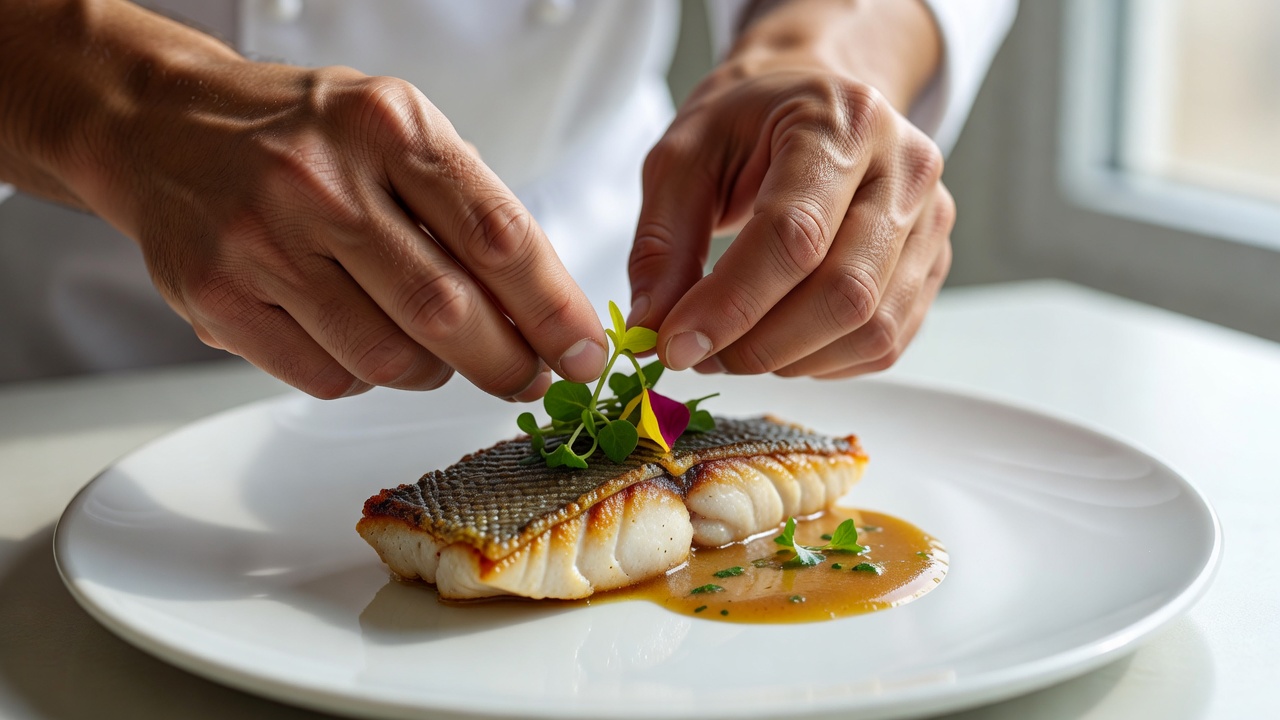
The eye often reaches a seafood dish before its aroma does. A pearly slice against dark ceramic, a scallop's browned surface, the glint of a clear sauce: these contrasts suggest texture and care. They are invitations, not proof. A beautiful arrangement cannot certify origin, freshness or skill on its own. To read presentation intelligently, treat the visual impression as the beginning of a conversation with the food.
Seafood makes an unusually revealing subject because so much of its character is delicate. Translucency, moisture and the separation of flakes can change quickly. The plate is therefore not a static picture. It is a short-lived composition shaped by heat, time and the diner's movements. Its best qualities may disappear while someone searches for the perfect camera angle.
Find the focal point
Start by noticing where your eye settles. Size, height, contrast and empty space can all establish a focal point. A single piece of fish may occupy relatively little of a large plate yet remain unmistakably central. Alternatively, several shellfish may form a repeated rhythm. Neither approach is inherently more refined. The useful question is whether the arrangement makes the main ingredient legible.
Negative space is not simply unused ceramic. It can separate flavours, keep a crisp element away from liquid, or make a small portion feel deliberate. But a wide rim does not create value by itself. Look at the relationship between the edible components. If most of the plate's drama disappears once you imagine taking the first bite, the composition may be serving the image more than the meal.
Read colour and texture together
A pale fish against a pale sauce can feel quiet and coherent. Add a dark seaweed element and the eye acquires an anchor. Introduce herbs or roe and small points of colour change the rhythm again. None of these effects tells you whether a garnish belongs in the flavour structure. Colour should prompt a question about taste, not substitute for an answer.
Texture is more than the familiar contrast between soft and crunchy. A sauce can provide lubrication; a vegetable can offer resistance; a crumb can introduce a dry interruption. Think about proportion. A brittle garnish that overwhelms tender seafood in every bite may be visually elegant but sensorially clumsy. The most convincing contrast allows the main ingredient to remain recognisable.
Terms such as crudo, sashimi and ceviche also carry different culinary contexts. Crudo broadly signals a raw preparation in an Italian-language tradition; sashimi belongs to Japanese practices of cutting and serving; ceviche involves acidic seasoning within varied regional traditions. They are not interchangeable aesthetic labels. Their appearance alone does not establish handling practices, and acid treatment should not be assumed to make raw seafood microbiologically safe.
Notice the choreography of eating
Where a sauce is placed changes how you encounter it. A pool beneath the fish invites immediate contact; a separate spoonful leaves more choice; dots distribute small amounts across several bites. Observe whether you can combine the intended elements without dismantling a fragile tower. A dish should not require architectural anxiety to enjoy.
Temperature is another part of the design. Warm plates can support a hot preparation, while chilled vessels can help a cold one retain its character. Yet the result depends on timing, thickness and service conditions. Ice is not evidence of safety by itself, and a dramatic vessel is not a temperature-control system. The diner's practical experience matters more than the prop.
Shells, stones and decorative materials deserve particular clarity. Ask which elements are edible if the answer is uncertain. A shell can communicate origin or provide a familiar frame, but it can also complicate balance and cutlery. Good service makes the intended route through a dish understandable without making the guest feel tested.
Borrow a slower way of looking
Take a brief first look: identify the central ingredient, the contrasting textures and the likely path of a bite. Then eat while the dish is at its intended temperature. Notice whether the initial visual promise is fulfilled. A restrained plate may reveal more structure in the mouth than in a photograph; a spectacular one may be genuinely delicious. Neither deserves an automatic verdict.
Presentation is most rewarding when it tells the truth about the food. It can reveal a precise cut, honour an ingredient's shape and make a sauce intelligible. The final measure is not whether a plate resembles an artwork, but whether its visual choices make the seafood more understandable and more pleasurable to eat.