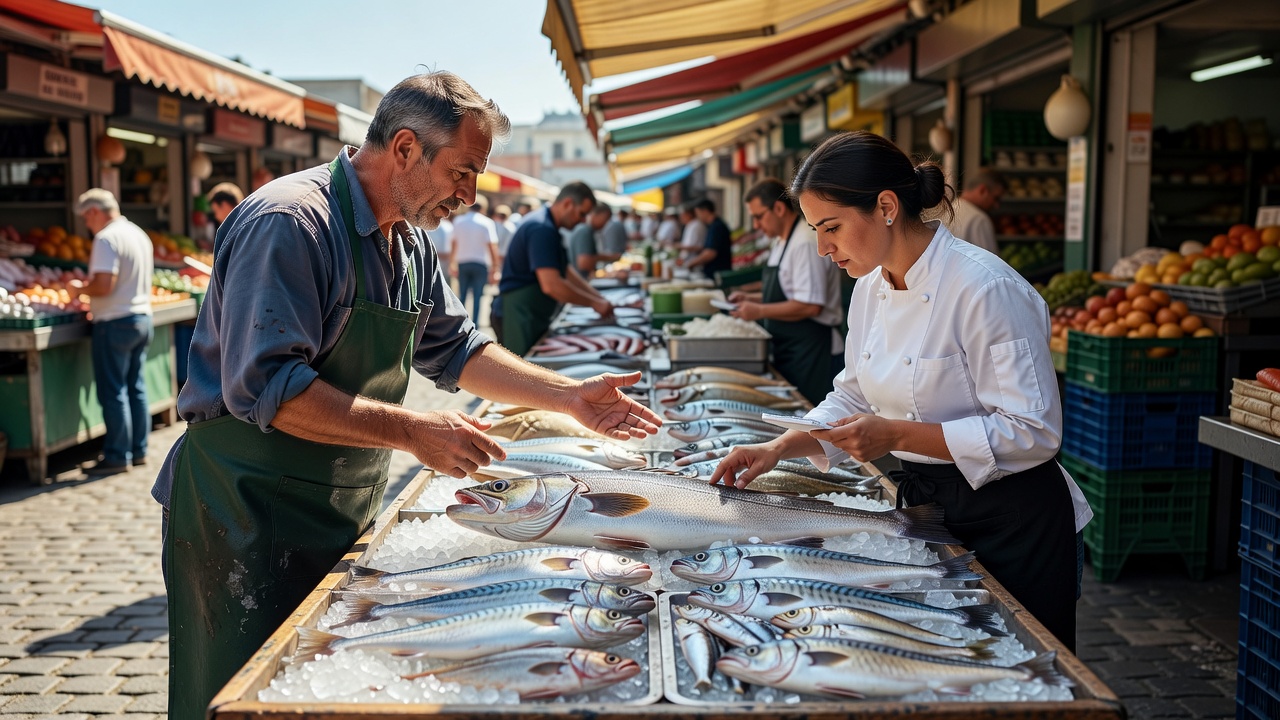
A seafood plate often arrives with a place attached: Cornwall, Brittany, Galicia, perhaps a particular island or bay. These names can express genuine relationships between a kitchen and its suppliers. They can also compress a complicated journey into one attractive word. Reading provenance well means slowing that story down, separating where an animal lived from where it was landed, processed, sold or served.
Begin with identity. “White fish” and “prawns” are broad descriptions, not precise species information. A common name may cover several species with different habitats and management concerns. You do not need to turn dinner into an examination, but asking which species is being served gives every subsequent question a clearer foundation. Where the answer matters, a scientific name can resolve ambiguity between regional names.
A port is not a fishing ground
Brixham, Newlyn and Peterhead are important names in British seafood trade. A fish associated with one of these ports was not necessarily caught immediately outside its harbour. Boats travel, markets aggregate landings, and distribution connects coastal towns with kitchens far inland. A named landing port is useful information, but it answers a different question from the location of capture.
The same care applies to imported seafood. Rungis, near Paris, is a major wholesale market rather than a marine origin. Galicia describes a substantial coastal region, not a single production site. The Rías Baixas have a strong association with mussel cultivation, yet a regional reference still needs the species and production details behind it. Precision makes a place name more interesting, not less evocative.
Methods are a beginning, not a verdict
Line-caught, pot-caught, dredged and hand-dived describe different interactions with the sea. They can help explain selectivity, seabed contact and the labour involved. None is a universal guarantee of low impact. Stock condition, incidental catch, local rules, fuel use and habitat sensitivity can change the assessment. Ask why the method suits this species and this place, rather than treating one word as a complete environmental score.
Aquaculture deserves the same attention. Rope-grown mussels, farmed salmon and land-based recirculating systems are not interchangeable categories. Feed requirements, water conditions, disease management, escape risks and local ecological effects differ. “Farmed” is not automatically a criticism; “wild” is not automatically a compliment. A thoughtful explanation names the system and acknowledges its relevant trade-offs.
Freshness also needs a more careful vocabulary. Rapid chilling, appropriate freezing, transport conditions and time all affect quality and safety. A well-handled frozen product can be an excellent culinary choice. “Never frozen” says little about everything else that happened between capture and service. A restaurant's handling practices matter, even when its sourcing story is compelling.
What certification can tell you
The Marine Stewardship Council, or MSC, operates standards for wild-capture fisheries and supply-chain traceability. The Aquaculture Stewardship Council, or ASC, addresses responsible aquaculture through its standards and assurance systems. Certification is specific: it relates to a defined operation, product or chain, not a blanket endorsement of every seafood item in a dining room. Ask what the claim actually covers.
The Marine Conservation Society's Good Fish Guide offers another kind of evidence, with assessments that distinguish species, areas and methods. Its advice can change as evidence changes. That is a reason to consult the current entry, not to memorise a permanent list of “good” and “bad” fish. Certifications and guides answer related but different questions; neither replaces food-safety controls.
Bring three questions to the table
A useful conversation can be brief: what species is this, where was it caught or grown, and how was it produced? If a server needs to check, allow that pause. A careful answer from the kitchen is better than a fluent guess. If the information is unavailable, recognise the uncertainty rather than filling it with assumptions about price or reputation.
The aim is not perfect knowledge before every bite. It is a more honest connection between the pleasure of a plate and the systems that made it possible. A provenance story becomes genuinely premium when its detail survives a follow-up question.